
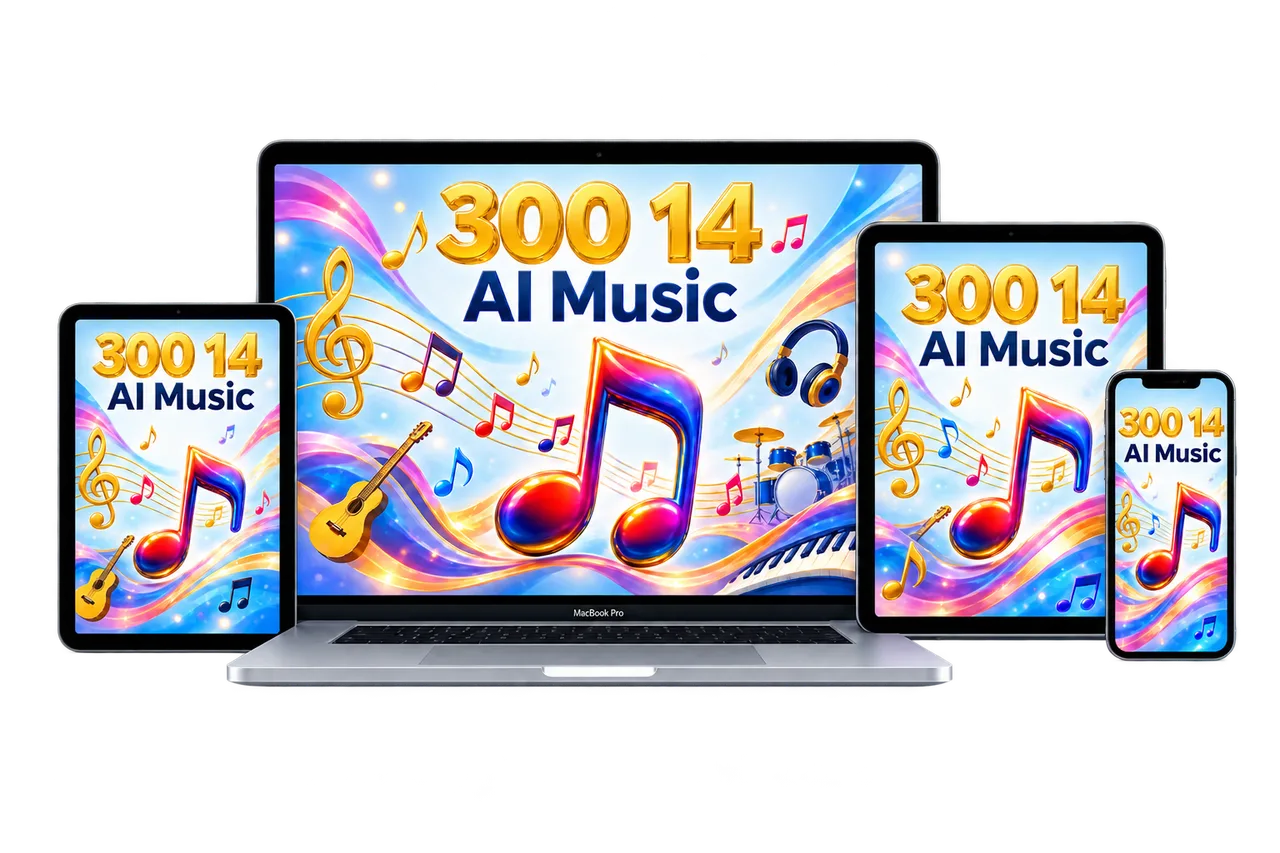
Creating a song without knowing how to play an instrument is now possible!
Imagine this for a moment.
You are sitting comfortably on your sofa. A melody comes to mind. You imagine a song combining classical piano, electronic rhythms, electric guitar and a voice worthy of a Hollywood film.
There is just one small problem: you cannot play any instrument.
Your last musical experience probably goes back to recorder lessons at school. And it is fair to say that nobody around you has been demanding the release of your first album.
But today, that could well change! 🎹
Thanks to artificial intelligence, it is now possible to turn a simple idea into a musical composition, complete with instruments, lyrics, arrangements and sometimes even a singing voice.
And the most fascinating thing is that this revolution is not just for music professionals.
It is also for people who never imagined they could compose a song in their lives.
1. When your imagination becomes your main instrument
For a long time, creating music meant mastering an instrument, learning music theory, understanding harmony or working with software that could be particularly complicated.
Those skills remain valuable. But they are no longer necessarily a requirement before you can begin experimenting.
Today, you can describe a mood, a musical genre, an emotion or an idea to an AI music tool.
For example, you could imagine:
- A romantic song inspired by a sunset on a beach.
- An epic track to accompany a hike in the Alps.
- Relaxing music for working or reading.
- A funny song for a friend's birthday.
- An anthem for your sports team.
- A Christmas song for your family.
- A soundtrack for your next holiday.
Your imagination becomes the starting point of the creative process.
Of course, the first results do not always match exactly what you had imagined. That is also what makes the experience fun: you can change your instructions, compare several versions and gradually refine your composition.
2. You can finally create a song for someone you love ❤️
Looking for an original gift?
Imagine giving someone a personalised song instead of yet another box of chocolates.
You could tell the story of your first meeting, recall holiday memories, celebrate a friendship or simply write a few funny lines about someone who matters to you.
A song for your grandmother's 80th birthday.
A romantic track for your partner.
A completely absurd song about the colleague who is always late.
A personalised nursery rhyme for your child.
There are plenty of possibilities.
And unlike a gift bought in a few seconds, a personalised song contains something deeply personal: your story, your ideas and your emotions.
Artificial intelligence then becomes a tool for giving a new form to what you want to express.
3. What if Beethoven met rap? 🎻
Let's get a little adventurous.
What would a composition combining the energy of rap, the power of a symphony orchestra and the sounds of classical piano be like?
Or a techno track accompanied by a violin?
Or perhaps a medieval song mixed with modern rock?
Music generation tools let you explore combinations of genres that you might never have considered before.
Jazz and electronic music.
Reggae and classical music.
Rock and Celtic music.
Hip-hop and a symphony orchestra.
Folk music and futuristic synthesisers.
Some experiments will produce beautiful results.
Others will probably sound like an international musical catastrophe.
But experimenting is part of the fun, after all!
One of the great attractions of these tools is being able to try different ideas without immediately having to bring together fifteen musicians, rent a studio and invest thousands of euros.
4. A new creative activity for the whole family
We spend a lot of time consuming digital content.
We watch videos, listen to music, browse social media and discover other people's creations.
But why not use some of that time to create something ourselves?
Imagine an evening where every member of your family invents their own song.
You choose a theme together, write a few lyrics, select a musical mood and compare the results.
Children can imagine extraordinary stories. Adults can share their memories. Grandparents can pass on family anecdotes in musical form.
You could even organise a song contest with friends.
The best track.
The funniest.
The most improbable.
The one that gets the whole family dancing.
The aim is not necessarily to become an international celebrity.
It can simply be about having a good time creating something together.
5. Will artificial intelligence replace musicians?
Of course, this revolution also raises important questions.
Some artists worry about competition from AI tools. Others question how creators are paid, copyright, the use of existing works and the place of human beings in artistic creation.
These concerns are legitimate.
Creating a song in a few minutes is not the same as spending years mastering an instrument, developing a musical identity or learning how to convey emotion on stage.
Software cannot replace the experience of a concert, the connection between musicians or the emotion a human performance can evoke, either.
But artificial intelligence can also be seen as a new instrument.
When photography appeared, it did not make painting disappear.
When synthesisers arrived, they did not make pianos useless.
When video editing software became accessible, it allowed more people to make their own films.
New forms of creation appeared alongside the existing ones.
One of the challenges will be to find a balance between innovation, respect for artists, transparency and fair compensation.
6. You could discover creativity you never knew you had
How many people have given up on making music because they thought they had no talent?
How many have abandoned songwriting because they did not know how to compose?
How many have dozens of creative ideas that have never taken shape?
Artificial intelligence can help people get past that first barrier.
You might begin by generating a little song for fun.
Then discover that you love writing lyrics.
Next, you might become interested in arrangements, instruments, song structure or music production techniques.
You might even feel like learning to play an instrument.
Artificial intelligence does not necessarily have to be seen as a shortcut for avoiding all learning.
It can also become a gateway to learning something new.
And who knows? You might discover an entirely new passion.
7. Imagine the soundtrack to your own life 🎬
Films have soundtracks.
So why not your life?
Imagine music associated with your first big trip.
A song to celebrate a new project.
A track to motivate you while exercising.
A relaxing composition for your mountain walks.
Music that reminds you of your childhood.
An anthem to celebrate an important moment.
You could create your own personal album, made up of tracks inspired by the different stages of your life.
You do not have to publish them on Spotify, sell them or play them to millions of people.
Some creations can simply be yours.
Because their real value is not measured in plays, but in the memories and emotions they represent.
8. Rediscover different musical styles
Music generation can also be a wonderful invitation to explore genres you know little about.
Why not try composing a jazz track?
Then some music inspired by the Baroque?
Next, an electronic track, an orchestral piece or a song with African, Celtic or Latin American influences?
By comparing the results, you can discover new sounds and become interested in the history of different musical movements.
You could even have fun turning your own lyrics into several musical versions.
A rock version.
An acoustic version.
A disco version.
A classical version.
A particularly energetic techno version.
The same lyrics can evoke completely different emotions depending on how they are performed.
And you will soon understand why music is such a fascinating language.
9. Create music to accompany your other passions
Do you enjoy making videos?
Creating holiday slideshows?
Sharing stories online?
Organising events?
Producing podcasts?
AI-assisted music creation can complement all these activities.
You could design a musical atmosphere that precisely matches the world of your project.
Mysterious music for a fantasy story.
A lively track for a travel video.
A gentle melody for an inspiring story.
A recognisable musical theme for your programme or video channel.
If you are considering public or commercial distribution, remember to check the chosen tool's terms of use, applicable licences and any third-party rights.
Not all services offer the same usage rights.
It is better to take a few minutes to check these details before publishing your next masterpiece.
10. What if you simply tried it for fun?
In everyday life, everything sometimes seems to have to be productive.
We are expected to learn faster, work harder, optimise our time, develop our skills and reach new goals.
But we are also allowed to create simply because we enjoy it.
You do not need to become a famous composer.
You do not need to launch a musical career.
You do not even need to show your creation to anyone.
You can simply imagine a song, experiment, laugh at improbable results and enjoy seeing an idea take shape.
And in a world where we are constantly encouraged to consume other people's creations, rediscovering the pleasure of creating something ourselves may be one of the most beautiful possibilities these new technologies offer.
Your next piece of music might begin today
Artificial intelligence will not turn every one of us into the next Mozart.
But it allows many more people to explore a creative world that once seemed out of reach.
It opens doors.
It invites experimentation.
It encourages curiosity.
And above all, it reminds us that human imagination still has many ways to express itself.
So, what will your first song be? 🎵
Dreamlife.cool — Because the world has beautiful stories to tell, too. 🌅